
美姐
Australia, Vietnam expand cooperation during To Lam visit; media’s China-targeting framing ignores Hanoi’s strategic autonomy: expert_我的网站

A | "I think the end of the Johnson administration is a positive thing, despite the infighting," says Rodney Atkinson, an academic and political and economic commentator. "The candidates may be promising irresponsible tax cuts and not understanding how the economy works but the public debate is more mature and in the end the right policies could emerge.",One of the candidates, Sajid Javid, former health secretary, vowed to axe the former chancellor’s plans to raise the corporation tax from 19% to 25% in April 2023, and decrease the rate to 15%. His competitor Jeremy Hunt pledged the lowest rate of business taxes in the Western world, while Liz Truss, yet another contender, is also willing to adhere to "low-tax principles." In contrast, former Chancellor Rishi Sunak, who is seeking the prime ministership along with his party fellows, has placed emphasis on "fiscal prudence" rather than tax cuts, while criticizing other candidates for offering "comforting fairytales.","There are two economic issues here," explains Gayle Allard, a professor of economics at IE University in Spain. "One is the debt, which is clearly a problem for the UK and which would be aggravated by tax cuts. The other is the dilemma between trying to restart growth (which requires a tax cut) and to control very high inflation (which requires a tax increase). And then there is a political objective: voters like tax cuts. Which will win out? I would hope for a short-term tax increase, with the government keeping its promise to reduce it later. I think that makes the most sense.",According to Atkinson, those who are promoting tax cuts without at least equal cuts in state spending are "totally irresponsible.",While the bulk of the candidates are promising anything between 20 and 40 billion in tax cuts, what everyone's really pledging is "to reverse the increase, which was implemented as of April 1," according to Marc Ostwald, chief economist at ADM Investor Services International.,"Let's take, for instance, the corporation tax cut which is being proposed," Ostwald says. "It's not actually a tax cut, because really all it is, is basically saying 'we're not going to implement the increase from 19% to 25% in corporation tax that is planned for next year.' Only Jeremy Hunt, I think, amongst them all is basically pledging to actually cut it down to 15%.",UK's Tory Government Faces Social Collapse, Having No-One But Itself to Blame21 June, 05:48 GMT,However, there are plenty of problems that cannot be fixed by the much-discussed tax cuts, Ostwald underscores: "The UK's infrastructure is atrocious; the level of poverty in the country is bad; the cost of living crisis [is] somewhat worse in the UK than across much of the rest of the developed world.",British unions kicked off a series of industrial actions starting from June 2022, demanding pay raises in line with skyrocketing inflation and protesting over the cost of living crisis. Tens of thousands of railway workers walked off the job in Britain on June 21. Criminal law barristers took to the streets on June 27. Teachers' unions and the civil service have been balloted on possible industrial action, while doctors and nurses are threatening to follow suit. Meanwhile, British rail and transport workers have voted in favor of a new strike in July.,There are also a whole array of problems related to Brexit, including red tape and other "non-tariff barriers" which translated into additional costs for businesses and are eating away at their margins, according to the economist. He laments the fact that neither the Tory nor Labour Party has so far proposed any solutions to these problems.,'We Want to Save Lives': How Tory Cabinets Pushed NHS to the Wall, Disregarded Nation's Health28 June, 17:52 GMT,UK's Political Instability Making Crisis Worse,The unfolding socio-economic instability has been exacerbated by Johnson's resignation and the internal infighting among British Tories is to some extent "damaging the economy by creating unnecessary uncertainty," according to Kevin Dowd, professor of finance and economics at Durham University.,"[A] lot will depend on who wins the leadership," Dowd says. "There are one, maybe two, decent candidates in there but for the most part they are a sorry lot, and I am not optimistic that a good prime minister will emerge… Most if not all of these people do not have a strong grasp of what the country needs, so I expect a lot more policy drift and a bad outcome for the Tories in the next general election.",A big number of contenders for BoJo's position "shows actually that Johnson has left a bit of a vacuum, because he was to some extent actually quite popular, despite all his lies, despite all his gaffes, despite his incompetent policies, despite all the back to and froing," according to Ostwald.,However, none of the 11 contenders "stands out as a genuine leader, as a prime minister, as a leader of a country," the economist emphasizes.,Boris Johnson Pledges Not to Back Any Tory Bidder as 'Dirty' Leadership Race Gains SteamYesterday, 14:30 GMT,'It's Johnson's Fault',It is Johnson who bears "90 percent" of responsibility for the current crisis, the economic observers argue.,"[Johnson] had let state finances get out of control before the COVID Lockdown spending," Atkinson says. "He has been the most irresponsible prime minister since Edward Heath who between 1970 and 1974 led a spending and monetary expansion boom. It resulted in the International Monetary Fund (IMF) controlling the UK economy in 1975. Johnson’s first instinct was more Government and more spending and more borrowing. We will be paying for his failure for decades.",Johnson "must bear a lot of the blame," Kevin Dowd agrees. While having a huge parliamentary majority and the opportunity to make radical reforms free of the shackles of the EU, Johnson "blew it," according to the professor.,"What are the chances of the UK going into recession? I think it's pretty much baked in the cake," echoes Ostwald. "There isn't a lot of momentum there. The trade position is getting worse. The cost of living crisis is quite clearly there and the investment into the UK is getting weaker and I would add that this whole methodology of applying sanctions by seizing assets is particularly bad for the UK. The UK has been attracting foreign capital from Russia, from the Middle East, from Asia, from pretty much anywhere that one can think of for a very, very long time.",However, it's not only the outgoing prime minister who is responsible for the current crisis in the UK, the economist admits: "These have been accumulating for years. People have been going to the food banks in the UK since the numbers started rising in the early 2010s after the global financial crisis and the numbers got a lot worse than in the meantime, particularly due to the cost of living crisis," Ostwald concluded.。

B |
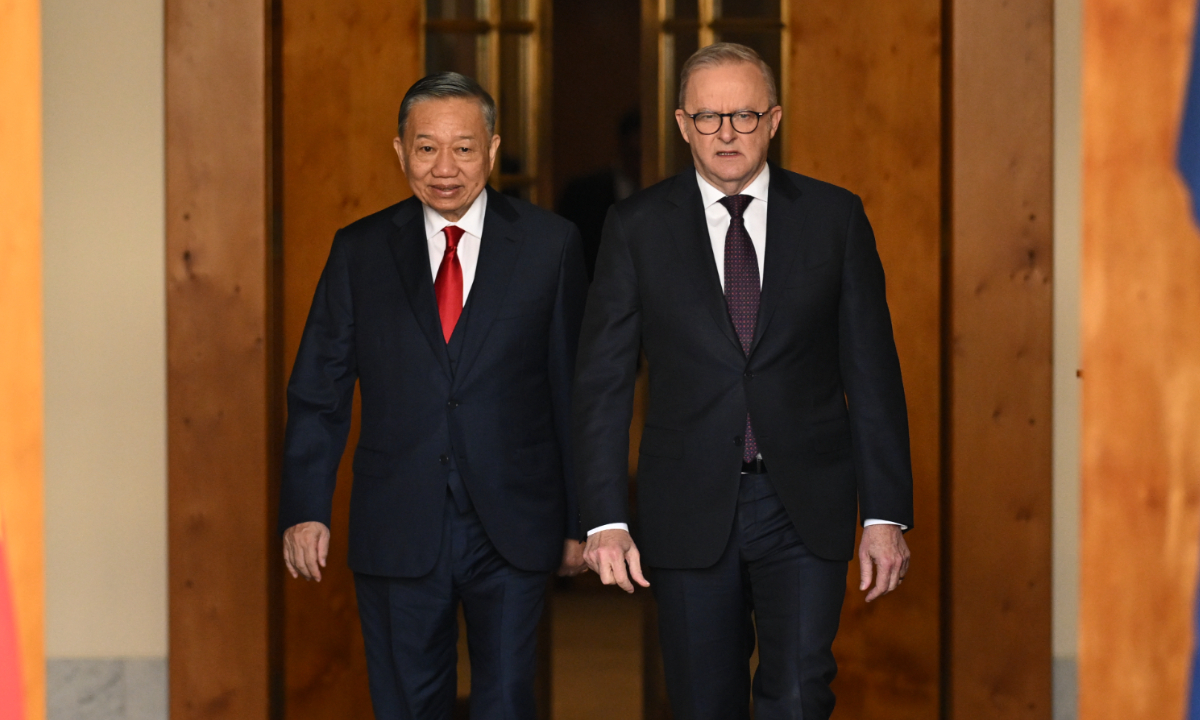
Vietnamese President To Lam and Australian Prime Minister Anthony Albanese pledged on Tuesday to broaden cooperation across major areas including defense, maritime and border security, agriculture, energy and minerals during Lam's visit to Australia.
Although neither the joint statement nor the joint media statement issued during the visit mentioned China, some media outlets framed the expanded cooperation as a joint effort to counter Beijing. A Chinese expert said such narratives repackage normal bilateral engagement through the lens of the so-called "China threat" narrative while disregarding Vietnam's strategic autonomy.
The joint statement between Vietnam and Australia outlined bilateral cooperation in major areas, including deepening political, defense, security and justice cooperation, enhancing economic engagement, strengthening climate, environment and energy cooperation, and reinforcing regional and international cooperation.
The outcomes included memorandums of understanding on cooperation and the resumption of market access for Australian kangaroo and deer meat in Vietnam, demonstrating that the visit covered a wide range of economic, security and regional issues.
Despite the broad agenda, The Straits Times portrayed the two countries' stronger military ties as being "in [a] nod to China." It described their expanded military cooperation as part of efforts to "face down Beijing's expanding reach in the Pacific and the South China Sea," and said Lam's visit came as the two countries "chafe against a growing military build-up by China in the region."
Bloomberg likewise linked the cooperation to China, claiming that "Australia and Vietnam have expanded maritime-security cooperation in recent years as they confront increasing Chinese 'aggression' in the South China Sea."
Australia has sought in recent years to embed itself more deeply in the regional maritime-security architecture through partnerships with Southeast Asian countries, and its latest cooperation with Vietnam is consistent with that trend, Chen Hong, director of the Australian Studies Center at East China Normal University, told the Global Times on Tuesday.
However, this does not mean Vietnam is inviting Australia to involve itself in the South China Sea or join in efforts to contain China, Chen said. He described some media's framing as the latest example of agenda-setting that exploits regional issues, including the South China Sea, to view Australia-Vietnam cooperation through lens of countering China.
On the South China Sea, the joint statement said: "Leaders expressed concern about the situation in the South China Sea and re-emphasized the importance of upholding peace, security, stability, freedom of navigation and overflight."
"They reiterated the importance of the full and effective implementation of the 2002 Declaration on the Conduct of the Parties in the South China Sea in its entirety. They noted that any Code of Conduct on the South China Sea must be effective, substantive, in accordance with international law, particularly the UNCLOS, and not affect the enjoyment of the rights of any state under international law."
China has also consistently expressed support for international law and the Declaration on the Conduct of the Parties in the South China Sea, while stressing the importance of managing differences, advancing cooperation and safeguarding regional peace and stability, Chen said.
Attempts to tie Australia-Vietnam cooperation to a "China threat" narrative seek to create the impression that regional countries are forming a united front to balance China, he noted.
Such framing not only smears China but also erases Vietnam's strategic autonomy, Chen said. Vietnam can safeguard its maritime interests and develop relations with Australia while attaching great importance to its ties with China, and these objectives are not contradictory.
Interpreting Australia-Vietnam defense cooperation as being directed against China reflects Cold War-style bloc thinking and seeks to securitize China-related issues, Chen said, adding that attempts to portray regional cooperation as part of a strategy to contain China warrant vigilance.
。
Current article:http://gqt.caonaishengpengchuali.shop/nxxa/20260826/4362.html
Published on:10:11:14
 宏碁暗影骑士 · 擎 8 游戏本上市:14650HX + 5060 配置国补后 8999 元
 金杯汽车:上半年净利润9291.28万元,同比下降9.7%
 特斯拉中国:FSD入华筹备的上海数据中心没有“人去楼空”!
 多地有雷阵雨或阵雨,个别地点有暴雨,最高温37℃,河北最新出行信息请查收→
 从意念游戏到量子计算整机落地,未来产业在WAIC上有了实感
 造型彰显黄河意蕴 济南黄河体育中心体育馆加速打造城市文体新地标